Resistance Training in Midlife with Joanna McMeikan
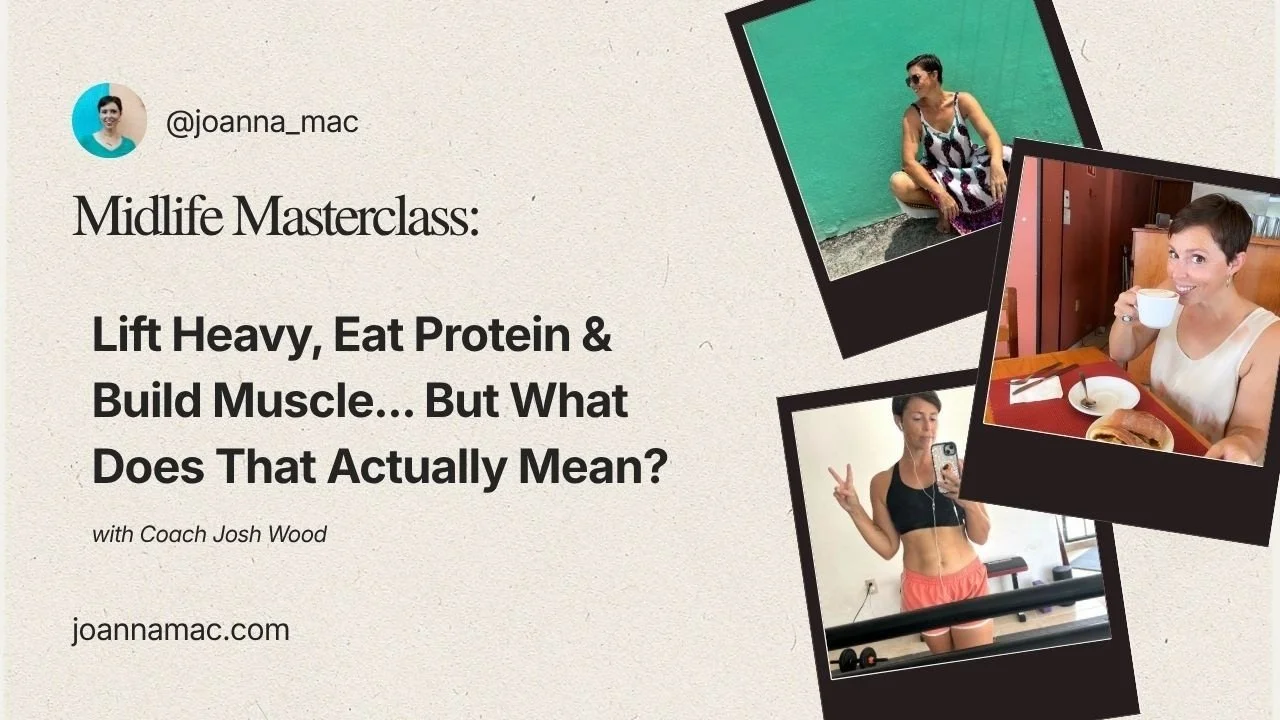
I recently sat down with Joanna MacMeikan for one of her Midlife Masterclass conversations. We covered a lot of ground around resistance training, perimenopause, and the endless noise women are currently getting online about “lifting heavy” and HRT.
A lot of the current messaging makes it sound like if you’re a woman over 40 and you’re not on HRT and lifting heavy three times a week, you’re basically neglecting your future self. That’s not how I see it.
Why Resistance Training Matters
As we age, we naturally lose muscle, bone density, and coordination. That’s just reality. Resistance training is one of the few things that actively pushes back against that process. It helps maintain muscle, keeps bones stronger, supports metabolism, and improves how you move through daily life.
The good news is your body still responds to training at any age. The bad news is most people wait until things feel noticeably worse before they start. It’s never too late, but it’s definitely easier if you’ve been doing something consistently for longer.
What “Lift Heavy” Actually Means
This one confuses a lot of women.
“Heavy” doesn’t mean you need to be squatting with your bodyweight on your back or grinding out low-rep sets with a barbell. It means the weight (or resistance) is challenging for you in that moment.
The goal is to get close to technical failure on most sets — the point where the last 2–3 reps are genuinely difficult, but you can still do them with decent form. That’s the ideal stimulus in most cases. Everything else is just details.
Progressive Overload Without Over Complicating It
Your body adapts to what you repeatedly do. If you want it to keep adapting, you need to gradually make things harder over time. That could mean:
Adding a little weight
Doing one more rep
Slowing the movement down
Doing the same work in less time
You don’t need to chase this every single session. But over weeks and months, the trend should be upward. If you’re doing the same 3 sets of 10 with the same weight for six months, you’ve stopped giving your body a reason to change.
Protein and Recovery
You need more protein than most people think, especially if you want to maintain (or build) muscle. A simple target for most people is around 1.6g per kilogram of body weight. Practically, that usually means getting a solid palm-sized portion of protein with each meal.
Recovery matters too. The harder the session, the longer you need before you can repeat that same effort. Most people training for health and longevity don’t need to train to absolute failure every set. Leave a little in the tank and train consistently instead.
Keep It Simple
You don’t need a complicated program. The basics cover most of what people need:
Squat (or sit-to-stand variations)
Hinge (picking something up off the ground)
Push (pushing something away or overhead)
Pull (pulling something toward you)
Some form of core work
Do these movements regularly, make them gradually harder, and eat enough protein. That’s the majority of the game for most people.
The biggest mistake I see is people waiting until they feel they have the “perfect” plan, the right gym, or the ideal conditions. Just start with what you have. Use water bottles, a backpack, resistance bands, or your own bodyweight. Improve from there.
If this is resonating with you, then you can learn more about my coaching here:
Watch the full masterclass: